An Appcues alternative — with a free plan and published prices
Appcues is a mature onboarding platform. Its pricing page lists three plans — Start, Grow and Enterprise — priced by monthly active users, installations and the number of published experiences, with no dollar figures and no free plan. Clew covers the core web formats — tours, tooltips, checklists, modals — with a free plan forever, prices on the website and the option to run it on your own servers. Below: the table, what Appcues does better, and the cases where switching would be a mistake.
Clew vs Appcues, point by point
| Feature | Clew | Appcues |
|---|---|---|
| What it is | Web onboarding: tours, tooltips, checklists, modals | In-app flows, checklists, banners, NPS and surveys, launchpads |
| Free plan | Yes, forever | No — free trial only |
| Price | Free forever (1 site, 3 published tours, no visitor caps); paid from $14.99/mo | No dollar prices published; quoted per plan |
| What the price counts | Published tours (20 on Pro); no visitor caps | Monthly active users, installations and published experiences |
| Published experiences | 3 on Free, 20 on Pro | 10 on Start, 25 on Grow, 100 on Enterprise |
| Self-hosted | Yes (Docker, your server) | Not stated — cloud product |
| Builder | Visual editor on your live page | Appcues Builder Chrome extension |
| Mobile apps | Web only | Web and native mobile SDKs |
| Surveys / NPS | Not yet | Yes |
| Integrations | A handful; events go to your analytics | A large catalogue of built-in integrations |
Comparison based on public information as of September 2026 — the vendors' own pricing, product and help pages. Features and prices change; if something here is outdated or inaccurate, email hello@getclew.io and we will fix it.
Who should not switch to Clew
The honest list. If you recognise yourself here, stay where you are — a migration will cost you more than the licence saves.
- You onboard people inside a native mobile app. Clew is web only: web apps, portals, websites. Appcues has iOS and Android SDKs. There is no workaround.
- NPS and in-app surveys are part of the same programme. Clew does not do surveys yet. Running them in a second tool means a second script, a second audience model and two sets of numbers.
- You depend on a specific integration. If your flows are wired into a CDP, a data warehouse or a marketing suite through the Appcues catalogue, check the same route exists before you move; Clew sends events to your own analytics and has a short list of built-in destinations.
- Appcues is already working and nobody is complaining about the bill. Onboarding content is worth more than the tool under it. Rebuilding a dozen live flows to save a subscription is usually a bad trade.
- You need an enterprise procurement package. Audit reports, a vendor security review with a named team, contractual SLAs, a dedicated customer success manager — Appcues has that machinery; we are a small team.
Where Clew does fit: a web product, a small or mid-size team, onboarding built and edited by product or marketing, published prices, and — when a security review demands it — the whole thing on your own servers.
If you do move: what a migration actually involves
- List what is live. Write down every published Appcues experience with its audience rule and its numbers. Most teams find a third of them are dead.
- Rebuild the ones that earn their place in the Clew editor, by clicking the elements on your live page. Anchors you already added for Appcues —
data-attributes, stable ids — keep working. - Move the targeting. Properties you pass to Appcues go to
Clew.identify()instead; page rules are exact path, prefix, contains or a regular expression. - Run both for a week with the Appcues flows paused, so you can switch back in one step if something is missing.
- Remove the Appcues script once the numbers on the new flows look like the old ones.
Budget a day or two for a handful of flows, not a sprint. The long pole is deciding what not to rebuild.
A hint inside your product
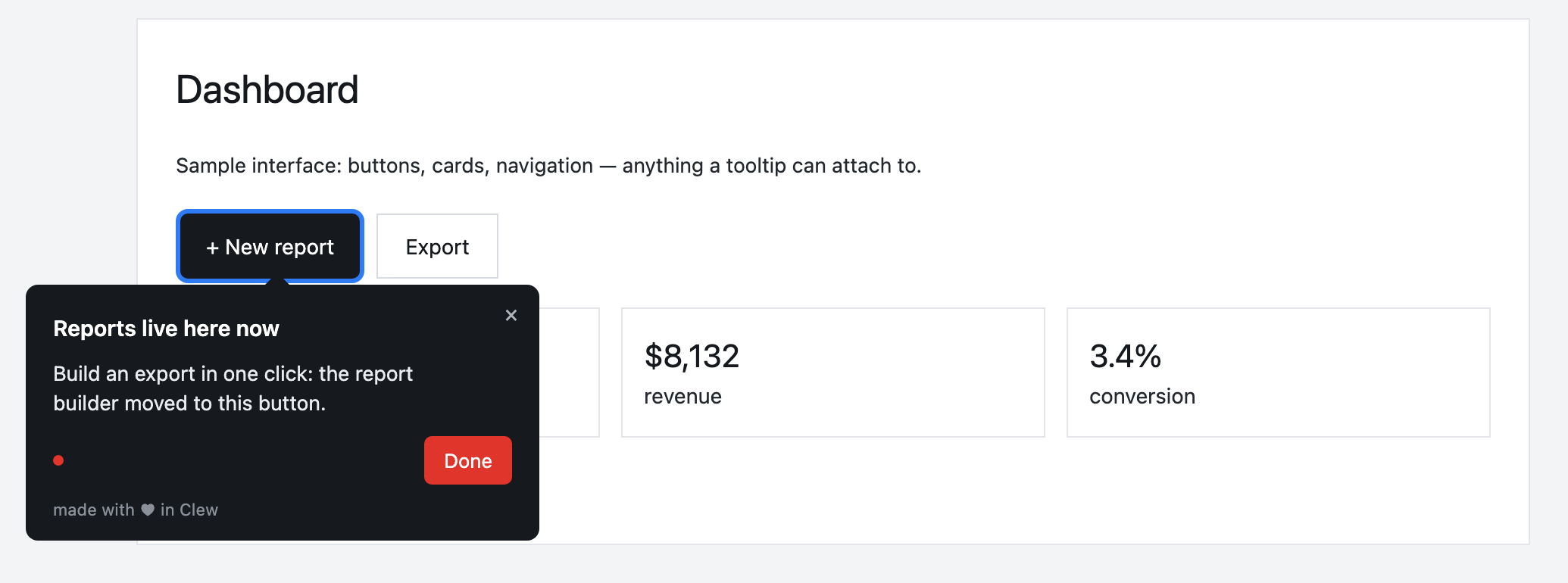
A tour, tooltip, checklist or modal — built in the visual editor and shown by URL, segment, trigger and frequency. A product manager or marketer edits it, with no release.
This is an illustrative scenario, not a real customer. Real customer stories will appear here as they happen.
Why teams pick Clew
Frequently asked questions
How much does Appcues cost?
Appcues does not publish dollar prices. As of September 26, 2026 its pricing page lists three plans — Start for up to 3,000 monthly active users with 10 published experiences, Grow from 3,000 MAU with 25, and Enterprise with custom volumes and 100 — and says pricing depends on monthly active users, installations and published experiences. You get a figure by starting a trial or booking a call. We are not going to quote a number we cannot verify.
Does Appcues have a free plan?
No. There is a free trial with no credit card required, during which you can show unlimited flows; after it, every plan is paid. The Clew free plan does not expire: one site and up to 3 published tours, with no visitor caps.
What are the main Appcues competitors?
Pendo, Userpilot, Chameleon, UserGuiding, WalkMe, Whatfix and the product tours inside Intercom, plus lightweight tools like Clew and the open-source tour libraries. Which one fits depends on whether you need mobile, analytics depth, surveys, or just onboarding in a web app.
What does Appcues do that Clew does not?
Native mobile onboarding through iOS and Android SDKs, NPS and in-app surveys, a launchpad and resource centre, and a much larger integrations catalogue. If any of those is on your list, Appcues is the better product for you.
Can Clew be self-hosted the way Appcues cannot?
Yes. Clew runs in Docker or as a single Node process with a built-in SQLite database, so visitor data stays inside your perimeter. Appcues is a cloud product and its pages state no self-hosted deployment.
Do I need a developer to set up onboarding?
Only once — to paste one script tag into your page. After that, product managers, marketers or support build tours, tooltips and checklists in a visual editor right on the live page, with no releases.
Does Clew work with React, Vue and single-page apps?
Yes. The widget is dependency-free vanilla JavaScript; it survives route changes in single-page apps and does not pull in a framework.
Can I self-host Clew?
Yes. Run it in Docker or as a single Node process with a built-in SQLite database; visitor data stays on your servers. The self-hosted edition is a one-time license with a year of updates and support.
How much does Clew cost?
The Free plan is free forever: 1 site and up to 3 published tours, no visitor caps. Pro ($14.99/month, 20 published tours, no visitor caps) and Business come with a 14-day trial, no credit card. There is also a one-time Lifetime license and a self-hosted box.